Saturday, 26 January 2013

Seeking Sanctuary


Where do you go when life gets too much for you?   

When everything’s getting on top of us, when we just can’t take it all any more, we need to escape to somewhere safe.  A refuge, a bolt-hole, an asylum, a shelter - a sanctuary.

In the Middle Ages a sanctuary was a place – often a church or monastery - where safety was guaranteed for people fleeing from arrest or prosecution. By the law of the medieval church, a fugitive from justice or a debtor was immune from arrest. If you’ve ever watched Derek Jacobi in Cadfael (or read Ellis Peters’ stories) you’ll know how that worked.  
If you were seeking sanctuary in those days, getting your hand on the door knocker was enough. You were safe and your pursuers couldn’t touch you. Next time you’re in Durham, grab hold of the sanctuary knocker on the main door (complete with protective gargoyle to ward off evil spirits) and breath a huge sigh of relief.

We don’t always have to go to such extremes. It is good to have our own personal sanctuaries, for those times when we just need to get away from it all.  You might find yours in the shed at the bottom of the garden, or on your allotment. Or jogging round the park, with your favourite tunes on your iPod. Or soaking in a hot bath with music and candles, and the bathroom door firmly locked.

When I was growing up in Dublin, family life was often stressful. To escape from all the hassle, I created a little library for myself in the outside toilet. I loved sitting there and reading. My brother Nick found a different refuge (usually from us older brothers wanting to beat him up!) in the branches of an old apple tree. Going through major life changes in my late 20s, the main place I felt safe was in my car, driving up and down the M6 between Manchester and Worcester.

Sadly, sanctuaries can become prisons. Lots of people use booze or drugs as a means of escape. They work for a while, giving that warm glow of comfort and forgetting. But too much for too long and they cause more problems than they solve.

If things are really, really bad – if you’re experiencing abuse or violence at home and don’t know how to get away from it - you may seek sanctuary inside your own head[1].  You find ways to watch what’s happening to you as if you’re outside the situation. It’s safer and easier than experiencing the pain or terror directly. But you risk losing touch with the rest of the world. As a GP, a lot of people with problems like this find ten minutes of sanctuary in my consulting room.  

How do you find sanctuary, when life gets too much for you?  


[1] I’ve touched on this before, a year or so ago in a post called What if you don’t feel at home?

Tuesday, 27 November 2012

A feather on your heart


Here is a message from my friend Mary. She has given me permission to post it. It speaks powerfully to my recent posts. The wonderful image of the feather on your heart will live with me for ever.

Hi Chris,

I hope you and all your family are really well and warm as the winter bites...

I finally got to reading your ‘Day of the Dead’ blog – not a big mystery why it took me a while to ‘go there’, given the loss of my mother in August and the energy one needs to cope and grieve.

Reading about the different celebrations and festivals surrounding the dead, I was very suddenly taken back to the room in my mother’s house where we brought her, after the hospital, after the undertakers, after choosing a coffin and jewellery and her favourite dark pink jacket to wear in farewell. And the astonishment I felt that she looked so like herself, lying there, with that fine delicate skin and those hands that so often held us safe, shaped our worlds, hands that told stories with abandon and sketched love, dismay, anger and longing on the air around us. Astonishment that, in that room in her house, it seemed there was no veil between the living and dead, and yet there was. Astonishment that someone so utterly vibrant could actually die. It’s changed me.

I feel I want to fight harder for a life lived well and vibrantly, because it doesn’t just land on you, you have to choose it and leave other things or people or stuff aside. And perhaps sometimes it does just land, like a feather on your heart. My mother Carmel had an extraordinary ability to take joy in the smallest thing and then she’d tell you all about it, so you got to share in her sense of joy in a world that can surprise, that can waft a feather straight to your heart. Her life was not easy but her spirit was indomitable. She taught me so much, far more than I ever understood or recognised.

On the Day of the Dead here in Ireland, I watched five of Tomas’ great nieces (all of one family) dress up respectively as Snow White, a leopard, a ghost, a ‘scary guy’ and a little red devil. They brimmed with the excitement of becoming something completely different, an unknown quantity, a mystery. The cold air clung to them as they pranced out into the dark and along the very quiet street of their small village, crossing over into a different realm. Maybe then I saw my mother, transformed into something entirely different, a mystery. Finally, they turned for home, rosy with excitement, coming in from the dark. When they hugged us (and can they hug!) they became known again, solid little bodies in our arms, familiar, warm, ours. So my mother. A mystery, but familiar, ours.

Thank you for the blog, and the stories that connect completely unknown people...

Take care

Mary

Thursday, 15 November 2012

Beside You

If you’ve been reading my posts for a while you’ll know than I love the music of Van Morrison.  My favourite album of his is Astral Weeks, recorded in New York over two days in 1968 when he was just 23. 
For me the best song on that album – probably my top song ever – is the second track, Beside You.  

You can listen to it here 
 
Here’s the bit that I love the most:
To never never never wonder why at all
To never never never wonder why it's gotta be
It has to be
And I'm beside you
Beside you
It’s the refrain, it weaves amongst the rest of the lyrics, simply supported by flute and acoustic guitar.
The meaning behind Morrison’s songs isn’t always easy to work out, and he is notoriously reluctant to explain himself. So we are left to make our own best interpretations of what he is singing about. 
I think Beside You is a celebration of the direct experience of unconditional love. It’s about loving being with someone just because you can. Because you’re there and they’re there, you’re together and it’s fine. No need for conversation or discussion, no questions asked, no demands made.  No trouble, no fret or worry. Being in this particular moment, with someone you care about, and knowing that this is entirely, totally sufficient.
Being together, in ‘the silence easy’.  
Which sets me thinking about my own Beside You moments.
I am fortunate to have so many people that I can be with, enjoyably, comfortably and without worry, that I am wonderfully spoilt for choice here.  
Here are three recent moments that spring to my mind:
·        On the couch in Mary’s house, with my most recent grand-daughter Florence snugglingly asleep on my left shoulder, watching my other four grandchildren playing on the floor and listening to Mary and Rachel discuss the imminent arrival of number six.

·        On a sun-lounger by the swimming pool in the Gulf Hotel in Bahrain, sipping mint and lemonade, reading Rose Tremain’s Merivel, the afternoon sun warming my skin, Sue dozing peacefully beside me.  

·        In a park in Canberra, pushing my brother Steve along the path in his wheelchair, watching a game of touch rugby, feeling in complete harmony as we share a joke about the game and realising that - whatever happens and whenever it happens – I will always remember this moment with joy.
Go well on your merry way. I hope you have a rich store of Beside You moments, and I wish you many more of them.


Monday, 5 November 2012

Day of the Dead responses

I have had some wonderfully rich and informative responses to my post about the Day of the Dead. I would like to share them with you all, so here they are:

Mari:
For last 5 years I have organised a welsh " light up a life" service... it’s a very moving service, all lay lead with no clergy, readings and carols by candlelight and an opportunity for anyone to come forward and light candles in memory of family and friends. At first service we expected about a 12 people - however half an hour before we were full and had to bring extra chairs and it has carried on being so popular year and year.  We do need to remember and opportunities to do so are important. 

Venetia:
In Sweden they have a similar approach – they light candles in graveyards and in every window of their houses and they have parties.  Giving out the light has especially good and cheering effects. It looked magical when I was there 6 years ago. Tomorrow I shall go and visit two friends who died young in the cemetery at the top of my hill.

Patricia:
For many death is the last taboo. Don't think or talk about it and maybe it will go away.... Then again, I suppose we get on with life precisely because we repress the awareness that one day we will not be around. All Souls' Day (2nd November) known as the Día de los Difuntos in Spain. The Spanish do visit the cemetery en masse to remember the departed, and there used to be the custom (maybe there still is) of spending the night in the cemetery, with lights, food and drink. Various traditions are observed throughout Spain, and special delicacies prepared for the occasion (for example, the "huesos de santo"). In Ireland, particularly in country areas, there is still the custom of holding a wake for the deceased in his or her own home. "Historically, the Celtic nations have always had a great respect for their ancestors and they believed that at certain times of year, the boundaries between mortals and the souls of the dead cease to exist. This is especially true of the “Three Nights of the End of Summer” - Hallowe’en, Samhain and All Soul’s Day. The ancients also believed that the dead were the repositories of wisdom and lore and that one of the reasons they return is to speak to their descendants. (Taken from an article by Bridget Hegarty.) I too would love a celebration in the churchyard where my father is buried in Ireland. He certainly would be present in spirit I think, as he loved any kind of celebration and get-together. We'd have some hot whiskey, a drink he always liked on a cold winter's night, and lots of good conversation. He was an excellent conversationalist. Whenever our family meet with relatives, some near, some distant, my father, and my mother, are remembered, with laughter, joy and a tear or two.... Pity Hallowe'en has become commercialised in recent decades. All Hallows´Eve, or Víspera de Todos los Santos. The old pagan feast of Samhain.
Hallowe'en (the eve of All Saints) in Ireland was a night for telling ghost stories around the fire, and these traditions still hold in many places. The spirits of the departed at a crossroads, the headless coachman, the black dog... We share these traditions with Galicia, in northern Spain, and Asturias and a few other northern provinces. Best to avoid the "Santa Compaña" (Peregrinación de los Muertos), as they mournfully glide in procession, in two lines, along a dark, lonely road, barefoot, shrouded, carrying invisible candles, and led by a living person carrying a light, holy water and a cross...... The Santa Compaña does not restrict its mournful expeditions just to Hallowe'en.

Coleman:
In many parts of rural Ireland, it is traditional to visit graves and to honor the dead on a specific day each year, known as a Pattern Day. The date varies from parish to parish. In preparation, graves are cleaned and decorated with new flowers and shrubs. Often, family members who have left the area will return , meet friends and neighbors at the cemetery and remember the dead.
Cemetery Sunday is a tradition that goes on the length and breadth of Ireland. Often held in August throughout Ireland. The Pattern is a festival (music, dance, eating and drinking) with origins in pre-Christian times. And occasion too, in the past (and no doubt in the present) for young men and women to meet and get to know one another). Sometimes patterns were held at Holy Wells.

Tuesday, 30 October 2012

Day of the Dead


Forget Halloween, it’s just a commercial nonsense. What’s much more interesting is the day after, 1 November. We call it All Saints Day. In Mexico it’s known as the Día de los Muertos, the Day of the Dead. 

If you think that sounds grim, macabre or spooky, you couldn’t be more wrong.  The Day of the Dead is a massive communal celebration. Thousands of families visit their local cemeteries and have parties at the gravesides of their dead relatives and ancestors. They build little altars at home, and decorate them with photographs and loved ones’ favourite foods.  It’s an event that goes back many hundreds of years, at least to the Aztec era.  
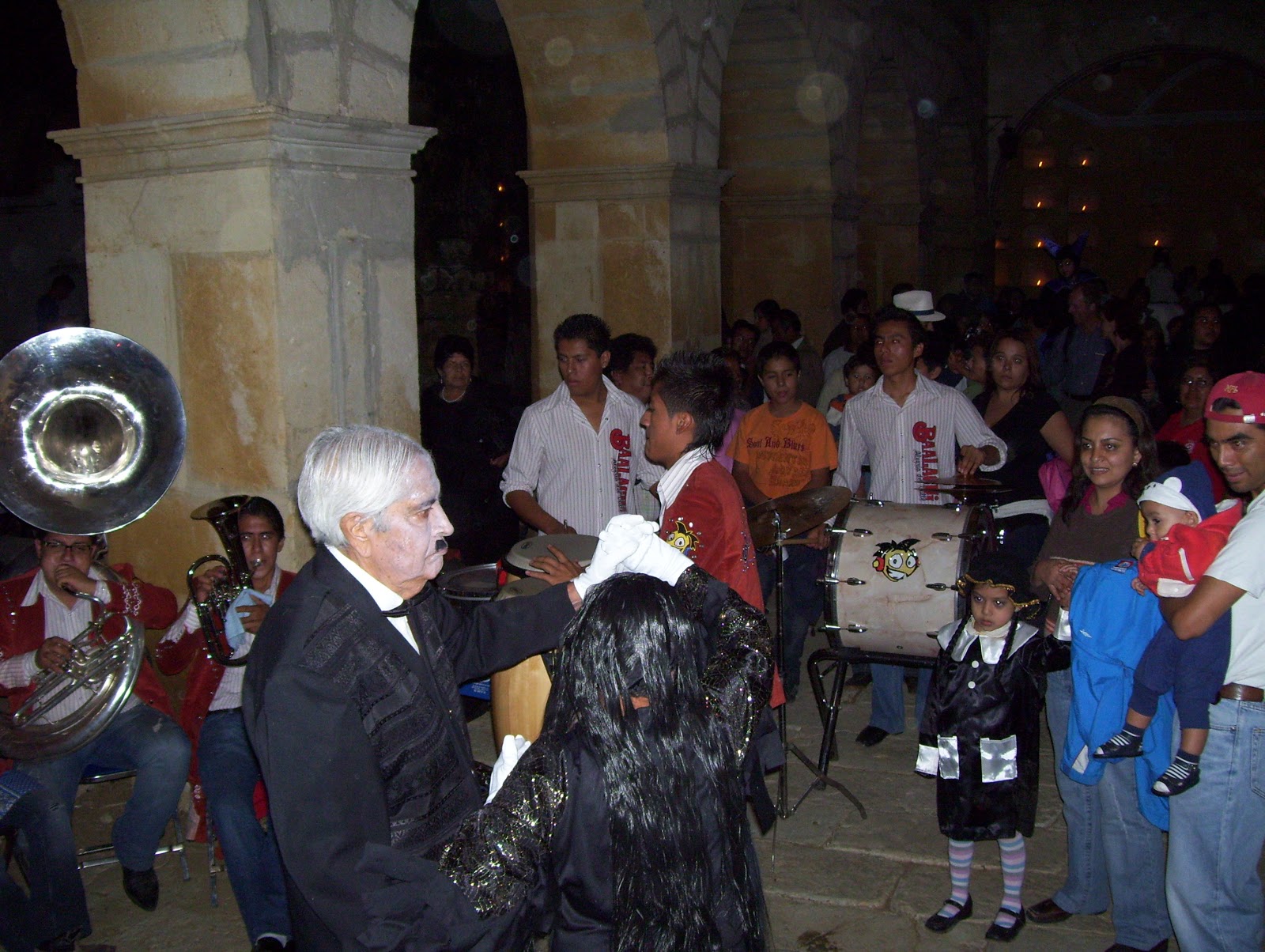
The biggest and best Mexican celebrations are in Oaxaca.  A couple of years ago Sue, Mike and I were there for the festivities.  We had a ball! The city cathedral was surrounded by hundreds of huge sand sculptures. The main cemetery was transformed into a place of light, with music and dancing, eating and drinking - bubbling with energy and excitement. It was full of joy.   
The nearest we get to this in our buttoned-up western culture is the Irish wake, when family and friends come together to celebrate the life of whoever has just died, often with their body present in the room.  There’s plenty to eat and drink, and laughter, with some good stories told.  But it’s different, it’s about just one person, and it only happens the one time.
Wouldn’t it be great to remember and celebrate our dead on a regular basis, and do it together? It would reaffirm our sense of who we are and where we belong, and remind us that we’re part of a big supportive community.  
Of course we might want to pick and choose a bit about who we’re remembering - there may be some people we are glad to have got away from. 
And since many of us move around a lot, we might have to work out the best place to do our celebrating. 
For me it would probably be the churchyard in Corbridge, Northumberland, where my father’s buried, near where he and his parents lived for many years. We’d need some big braziers to provide us with heat and light, as it can get pretty cold up there.  As well as the food and wine and singing (‘Blaydon Races’ would have to figure), we’d take a football and play a bit of 3-and-in.
Where would you hold your Day of the Dead? 
And what would you do to celebrate?
 

Monday, 27 August 2012

It’s OK to be Happy

Our son Mike married Paula a couple of weeks ago. It was a wonderful day. The ceremony was on the bank of a river in remotest Northumberland. The sun shone (amazingly!), Paula was radiant, Tom remembered the rings, and we all knew we were part of something special.
There were three great speeches during the wedding feast. Lots of fun stuff,  and a dollop of wisdom too. 
Mike told us how he and Paula first met, in a pub in Newcastle. They talked about all sorts of things that day, he said, “but most importantly, about the thing that would come to define us ever since then. I can't remember why we were talking about it, but we both agreed that in life, it was OK just to be happy. You didn’t need to worry about lots of stuff, or feel guilty about being happy. Being happy was just OK."
This is such a great message, I’ve been thinking a lot about it ever since.
Life isn’t always fun, not by any means.  It can be tough, unbearably so at times. It would be foolish to think that we can smile our way through everything that happens.  Of course we can’t.
Fortunately for most of us, most of the time, things aren’t that bad. But we are very good at finding reasons not to enjoy life when we can.
 Here are four bad reasons not to be happy, and some answers to them.
1.     I have no right to be happy.  There is so much suffering in the world, if I’m happy that means I am not taking all that suffering seriously. It means that I don’t feel enough for other people. I’m being selfish.
a.      How does your being miserable help relieve other people’s suffering? If you’re happy you’re probably also more creative and energetic, so more able to help where you can.

2.     Only stupid people are happy – they just don’t realise how complicated the world is, how easily things can go wrong, or how meaningless the universe is. 
a.      I used to believe this one, I’m sorry to say.  It’s patronising rubbish. Happiness does not derive from our understanding of the world, but from our reaction to that understanding. Go gather some more rosebuds.   
   
3.     I haven’t time to be happy. I am too busy doing stuff, sorting out my life and all the things I have to do, to stop and enjoy it all.
a.      You can enjoy the busy-ness. Getting immersed in things, to the point where you stop worrying about how you are feeling, can be a profound source of happiness.

4.     If I’m happy, it means I’m not trying hard enough.  Life is all about achievement, success, making the world a better place.  Allowing myself to be happy means I think I’ve done enough, and that can never be true – there is always more to be done.
a.      Another one of my own mental torments, coming from my protestant work ethic background. And maybe one I haven’t fully disposed of yet.  Time to re-read my post ‘The best is yet to be’! 
Desiderata, that famous poem that was on walls of many student homes back in the day, ends with the command: ‘Strive to be happy’.   Sorry, but that sounds too much like hard work to me. 
We don’t need to strive.  We can simply allow ourselves to feel good. We can give ourselves permission to be happy.
Really, it is OK.  

Sunday, 24 June 2012

Gathering Rosebuds

Life is precarious. It doesn’t matter how hard we work, or how carefully we plan, things will go wrong. A lot of the time we find ourselves surrounded by hassles and worries, or filled with boredom and tedium.  Sometimes it’s much worse – a severe accident, a life-threatening illness, or the untimely death of someone we love. So when we have glimpses of happiness, it is good to cherish and celebrate them.
Robert Herrick, 17th century poet, urges us to make the most of the good times while we can:
Gather ye rosebuds while ye may,
Old Time is still a-flying;
And this same flower that smiles today,
Tomorrow will be dying.

I’ve gathered a few fine rosebuds, this last week or so.
Last weekend was the big cycle ride from Carlisle to Liverpool (the reason for my two previous posts about cycling uphill).  Getting over Shap summit despite driving rain and a strong head wind was wonderful. Cruising the nine miles downhill to Kendal was even better. Exhilaration, feeling alive –all that and more.  Two rosebuds at least.
A bonus of distance cycling is that you can eat as much as you want, in fact you have to, to keep your energy up.  So slap-up breakfasts, mid-morning stops for double ice-creams and hot chocolate.  More rosebuds. Calories, who’s counting?
At the half way point, the entire family turned out to greet us. An evening with all my children and grandchildren, together in the same place.  A whole heap of rosebuds there.

This week Sue and I’ve been in Ireland, taking part in a GP conference in Kilkenny. Before that we had a couple of days over in the west, including a drive to Spanish Point, on County Clare’s Atlantic coastline.  Hard to believe it was midsummer’s day: wet, windy and cold. But it was beautiful, in a wild sort of way. We sat there for an hour or so, well wrapped up, eating apples and soda bread, watching four girls learning to surf, and listening to the waves breaking on the shore.
On the drive back the sun broke through the clouds, and I remembered Van Morrison’s wonderful song Coney Island. http://www.youtube.com/watch?v=cVyZfCDdkTY So, with apologies to Van, here’s my final rosebud:
I look at the side of your face as the sunlight comes streaming through the window in the summer sunshine. And all the time coming from Spanish Point, I’m thinking, “Wouldn’t it be great if it was like this all the time.”

Gathered any rosebuds yourself recently?